
Office Relocation Checklist: Everything You Need for a Smooth Move
Office relocations have a habit of looking simple right up until they’re not. On paper, it’s just moving from one space to another. In reality, there are dozens of moving parts — and it doesn’t take much for something small to throw everything off.
That’s exactly where most businesses slip up. Not because they don’t plan at all, but because they don’t structure that plan properly. Things get handled in the wrong order, key tasks get missed, and suddenly you’re dealing with delays, downtime, and a team that’s not quite sure what’s going on.
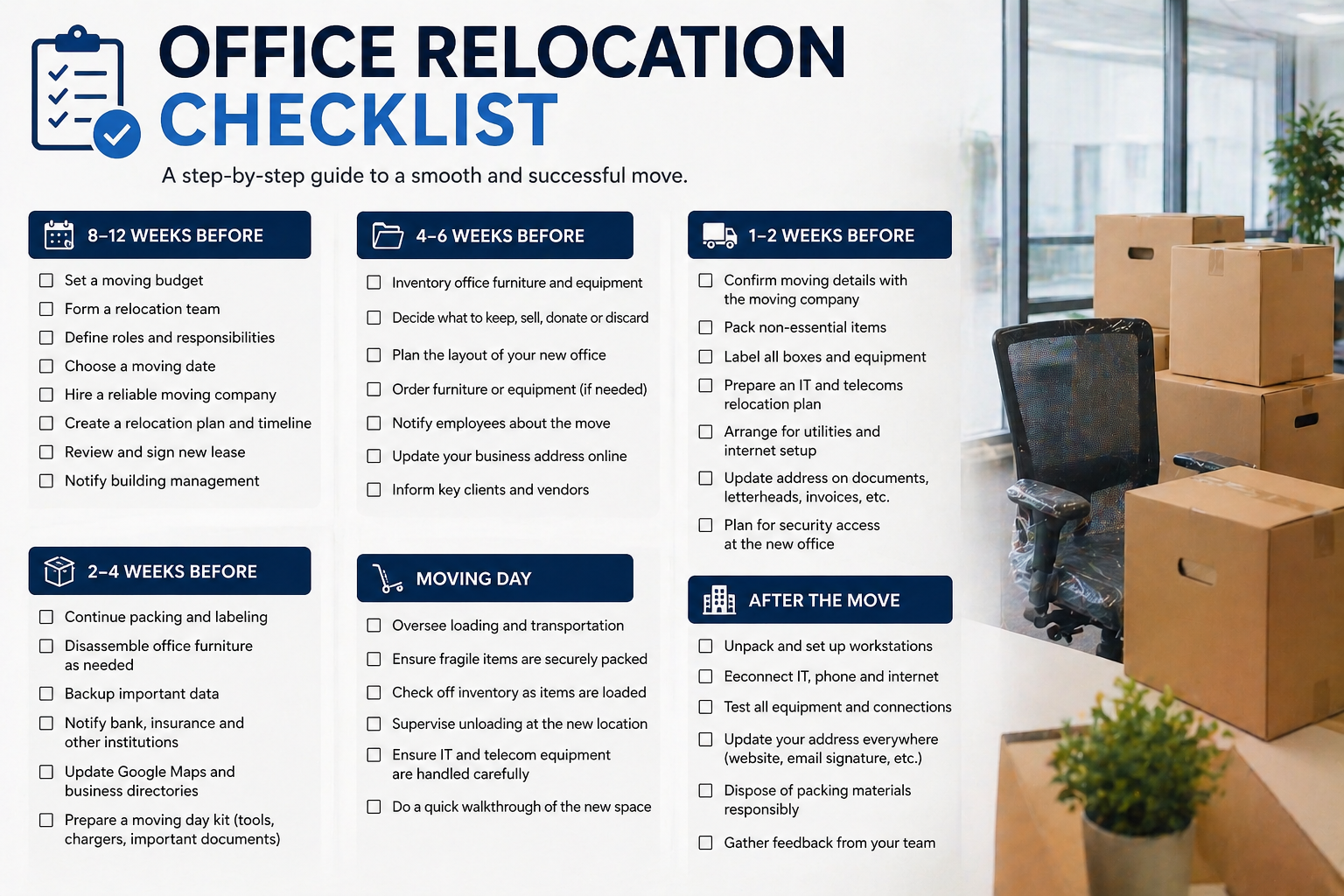
A solid office relocation checklist cuts through all of that. It gives you a clear sequence to follow, keeps everyone aligned, and makes sure nothing important gets overlooked. It’s not about making the move perfect — it’s about keeping it controlled.
In this guide, you’ll get a practical, no-nonsense checklist you can actually use. Something you can follow step by step, adapt to your business, and rely on when things start getting busy — which they will.
Office Relocation Timeline: When to Start Each Stage
Timing is where a lot of office moves quietly fall apart. Not because people don’t plan at all — but because they start too late, or try to do everything at once. A proper timeline spreads the workload out so you’re not scrambling in the final weeks.
For most UK businesses, a realistic window is 3 to 6 months. Smaller offices might get away with less, but anything beyond a basic setup needs breathing room. Here’s how that time usually breaks down.
3–6 Months Before the Move
This is your foundation stage. Nothing flashy, but it sets the tone for everything that follows.
At this point, you should be locking in your new space, agreeing on lease terms, and getting clear on why you’re moving in the first place. Growth, downsizing, location — whatever the reason, it shapes the rest of your decisions.
It’s also the right time to set a rough budget and start thinking about layout. Not in extreme detail, just enough to understand what the new space needs to work properly. If you leave this too late, you end up forcing decisions under pressure — and they’re rarely the right ones.
1–3 Months Before the Move
This is where things start getting more practical. You’ll be confirming suppliers, including your removal company, and beginning to organise the logistics of the move itself. Internet, utilities, and access to the new office should all be lined up around this stage — not left until the last minute.
It’s also a good time to communicate with staff properly. Not just a quick announcement, but clear information about timelines, expectations, and what’s changing. The more clarity people have now, the smoother things run later.
Final Weeks Before the Move
This is where the pressure tends to build — but it shouldn’t feel chaotic if the earlier stages were handled properly. Packing plans should be in place, responsibilities should be clear, and everything should feel fairly organised. You’re not figuring things out at this stage, you’re tightening them up.
It’s also when final checks start to matter more. Making sure access is sorted, confirming schedules with movers, and double-checking that nothing obvious has been missed. Small details make a big difference here.
Moving Week
At this point, it’s all about execution. Most of the real work should already be done. The focus now is on coordination — making sure everything happens when it’s supposed to, and dealing with any last-minute issues without them spiralling.
There’s always something unexpected, even with good planning. The difference is, it stays manageable instead of turning into a full disruption.
If there’s one thing to take from this, it’s this: rushing an office move rarely saves time. It usually just shifts the stress to the end — when you can least afford it.
The Complete Office Relocation Checklist
This is the part you’ll actually come back to. No long explanations. No overthinking. Just a clear structure you can follow without second-guessing every step. You won’t tick everything off in one go — and you’re not supposed to. The point is to keep things organised as the move progresses, so nothing slips through the cracks.
Pre-Move Essentials
- Define your relocation goals — Know why you’re moving in the first place. More space, lower costs, better location — it shapes every decision that follows.
- Set a realistic budget — Include more than just the move itself. Factor in IT setup, downtime, and any unexpected costs.
- Assign a relocation lead — One person needs to own the process and keep things moving. Without that, things drift.
- Create a high-level timeline — Not detailed planning yet, just a clear view of key dates and milestones.
Office & Space Preparation
- Confirm lease and access dates — Make sure timelines actually line up between old and new spaces.
- Plan the office layout — Think about how the space will be used, not just where desks go.
- Arrange utilities early — Internet, electricity, water — these need to be ready before day one.
- Check compliance requirements — Health and safety, fire regulations, access — don’t leave this until the end.
IT & Technical Setup
- Audit current equipment — Know exactly what you’re moving and what you’re not.
- Back up all critical data — Non-negotiable. Don’t risk losing anything during the move.
- Schedule installation and setup — Internet, phones, systems — timing matters here.
- Test systems before go-live — Catch problems early instead of on your first working day.
Staff & Communication
- Announce the move early — Give people time to process and prepare.
- Share clear timelines — Avoid confusion by being specific about dates and expectations.
- Assign responsibilities where needed — Packing, prep, coordination — spread the load properly.
- Address concerns upfront — Commute changes, workspace setup — small things that matter to people.
Moving Logistics
- Book your removal company — Lock this in early to avoid limited options.
- Create a packing plan — Don’t leave it to the last minute.
- Label everything clearly — It saves hours later. Seriously.
- Secure sensitive documents and equipment — Not everything should be treated the same.
Moving Day Checklist
- Confirm access at both locations — No delays getting in or out.
- Have a clear point of contact onsite — Someone needs to make quick decisions if needed.
- Keep communication open — Movers, staff, management — everyone should stay aligned.
- Prioritise critical equipment — IT and essential systems should be handled first.
Post-Move Checklist
- Test all systems immediately — Internet, phones, software — everything needs to work.
- Set up workstations properly — Don’t leave people half-set up. It slows everything down.
- Walk through the space — Spot issues early while they’re easy to fix.
- Resolve problems quickly — Small delays can drag on if ignored.
How Much Does Office Relocation Cost in the UK?
This is the question most businesses leave too late — and then get caught off guard. There’s no fixed price for an office relocation. It varies quite a bit depending on size, distance, and how complex your setup is. But you can get a realistic ballpark, and that’s usually enough to avoid nasty surprises.
For a small office (around 5–10 people), you’re typically looking at somewhere between £500 and £1,500 for a straightforward local move. That usually covers basic transport and handling, without anything too specialised.
A medium-sized office (10–50 employees) tends to land in the £1,500 to £5,000 range. At this level, you’re dealing with more equipment, more coordination, and often some level of IT handling or furniture dismantling.
For larger offices, costs can climb to £5,000–£20,000+, especially if you’re moving across cities, working with complex infrastructure, or requiring a full-service relocation. That includes packing, logistics, coordination, and setup support.
But the size of the office is only part of the story. Several factors push costs up or down. Distance is an obvious one — a move across town is very different from relocating to another city. Then there’s IT complexity. The more systems, servers, and infrastructure involved, the more planning and specialist handling you’ll need.
Access can also make a difference. Tight spaces, limited parking, lifts, or awkward layouts all add time — and time means cost. The level of service matters too. A basic “move only” job is cheaper than a full-service package where everything is packed, moved, and set up for you.
Then there are the costs people don’t always think about. Downtime is a big one. Even a short disruption can affect productivity, especially if systems aren’t ready straight away. There’s also temporary inefficiency after the move — people settling in, adjusting to the new space, figuring things out. It’s normal, but it still has a cost attached to it.
The key takeaway here isn’t to chase the lowest quote. It’s to understand what you’re paying for and where the risks are. A slightly higher upfront cost can save you a lot more if it means fewer delays, fewer problems, and a smoother transition overall.
Pre-Move vs Post-Move: What Most Businesses Forget
Most of the attention goes into the move itself. Packing, timelines, logistics, getting everything from A to B. That’s fair — it’s the most visible part. But it’s not where most problems actually show up. They show up after. Pre-move planning is usually handled well enough. People organise the basics, book the movers, sort the schedule. It might feel a bit rushed, but it gets done. The real gap is what happens once you’re in the new space.
That first week catches a lot of businesses off guard. Desks are in place, boxes are unpacked, but things still don’t feel fully operational. Systems might technically be working, but not smoothly. People don’t know where things are. Small issues start stacking up — missing equipment, unclear setups, awkward layouts. Nothing major on its own, but enough to slow everything down.
It’s rarely planned for. There’s this assumption that once the move is finished, everything goes back to normal straight away. In reality, there’s always a settling-in period. Teams need time to adjust. Workflows shift slightly. Even basic things like finding meeting rooms or shared equipment take longer at first.
That’s why the post-move phase matters just as much as the move itself. It’s not about doing more work — it’s about expecting that final stretch and allowing for it. Giving people space to get set up properly, fixing issues quickly, and making small adjustments before they turn into ongoing frustrations.
The businesses that handle relocations well aren’t the ones that avoid problems entirely. They’re the ones that plan for that adjustment period instead of pretending it won’t happen.
Takeaways
- A checklist keeps everything structured — It stops small gaps turning into bigger problems
- Start early and follow a timeline — Rushing the process creates unnecessary stress
- IT and systems should be ready first — If they’re not working, your business isn’t either
- Costs go beyond the move itself — Downtime and adjustment periods matter just as much
- The post-move phase is often overlooked — Plan for it, don’t assume everything clicks instantly